
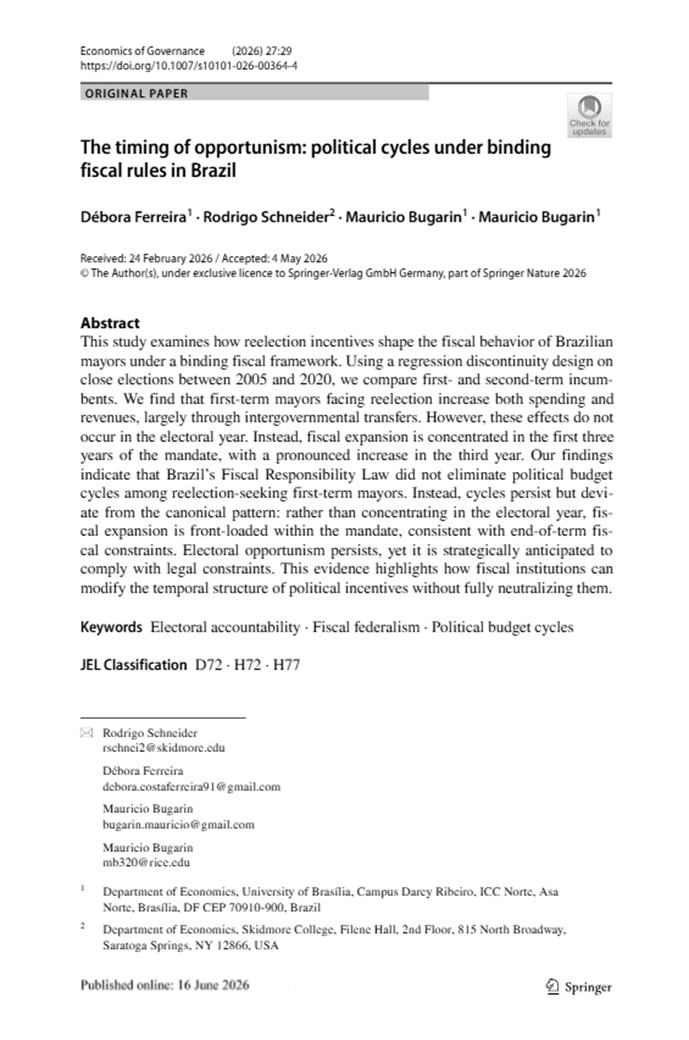
O artigo: “The timing of opportunism: political cycles under binding fiscal rules in Brazil“, coautorado por Débora Costa Ferreira e Rodrigo Schneider, foi publicado no periódico Economics of Governance em 17 de junho de 2026.
Resumo
Este estudo examina como os incentivos à reeleição moldam o comportamento fiscal dos prefeitos brasileiros sob um arcabouço fiscal restritivo. Utilizando um desenho de descontinuidade de regressão em eleições acirradas entre 2005 e 2020, comparamos prefeitos em primeiro mandato e prefeitos em segundo mandato. Verificamos que prefeitos em primeiro mandato que buscam a reeleição aumentam tanto os gastos quanto as receitas, principalmente por meio de transferências intergovernamentais. Contudo, esses efeitos não ocorrem no ano eleitoral. Em vez disso, a expansão fiscal concentra-se nos três primeiros anos do mandato, com um aumento particularmente pronunciado no terceiro ano. Nossos resultados indicam que a Lei de Responsabilidade Fiscal não eliminou os ciclos político-orçamentários entre prefeitos de primeiro mandato que buscam a reeleição, mas sim reformulou sua temporalidade ao impedir a concentração fiscal no final do mandato. O oportunismo eleitoral persiste, porém é antecipado estrategicamente para atender às restrições legais. Essa evidência mostra que instituições fiscais podem modificar a estrutura temporal dos incentivos políticos sem neutralizá-los completamente.
Palavras-chave: responsabilização eleitoral; federalismo fiscal; ciclos político-orçamentários.
O paper pode ser acessado aqui.
The paper “The timing of opportunism: political cycles under binding fiscal rules in Brazil“, coauthored with Débora Costa Ferreira and Rodrigo Schneider, was published in Economics of Governance on June 17, 2026.
Abstract: This study examines how reelection incentives shape the fiscal behavior of Brazilian mayors under a binding fiscal framework. Using a regression discontinuity design on close elections between 2005 and 2020, we compare first- and second-term incumbents. We find that first-term mayors facing reelection increase both spending and revenues, largely through intergovernmental transfers. However, these effects do not occur in the electoral year. Instead, fiscal expansion is concentrated in the first three years of the mandate, with a pronounced increase in the third year. Our findings indicate that Brazil’s Fiscal Responsibility Law did not eliminate political budget cycles among reelection-seeking first-term mayors. Instead, cycles persist but deviate from the canonical pattern: rather than concentrating in the electoral year, fiscal expansion is front-loaded within the mandate, consistent with end-of-term fiscal constraints. Electoral opportunism persists, yet it is strategically anticipated to comply with legal constraints. This evidence highlights how fiscal institutions can modify the temporal structure of political incentives without fully neutralizing them.
Key Words: Electoral accountability, Fiscal federalism, Political budget cycles.
The paper is available here.

